

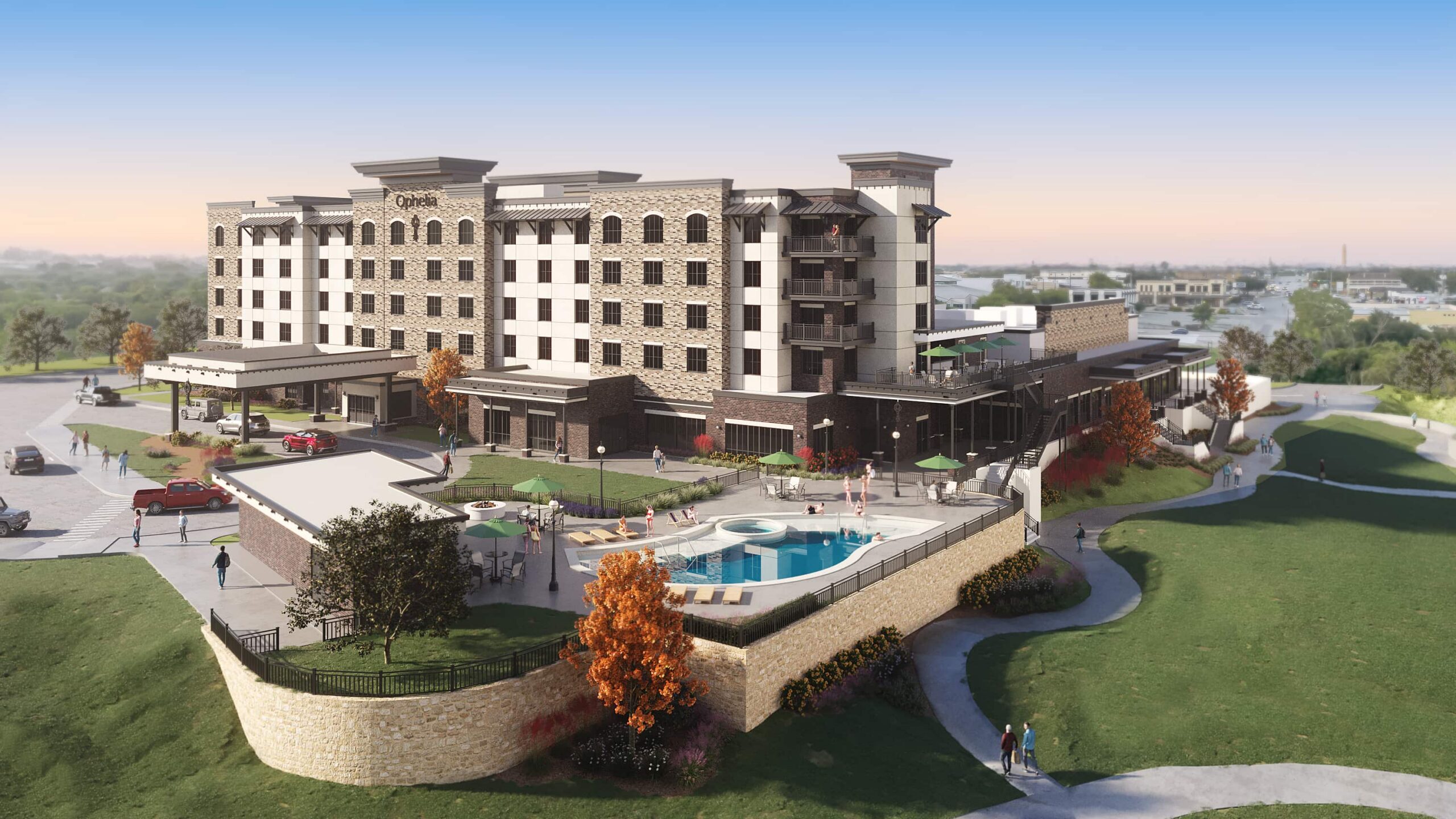
At the southern end of Main Street in Marble Falls, Texas, where the road gives way to Lakeside Park and the water beyond, a fivestory structure that has been more than a decade in the making is rising. The Ophelia Hotel Marble Falls, A Tapestry Collection by Hilton, is set to open in November 2026, bringing 127 guest rooms, over 9,000 square feet of meeting and event space and a signature bar and restaurant to one of the Texas Hill Country’s most beloved small-town downtowns.
The hotel takes its name from Ophelia “Birdie” Harwood, who in 1917 became the first female mayor elected in the state of Texas. It’s a fitting namesake for a project that has required no small amount of resolve to bring to life. The site spans approximately 2.9 acres at the intersection of Main and Yett streets, immediately adjacent to Lakeside Park and steps from the walkable historic downtown. At 70 feet, it’s by far the tallest structure in a community that has long drawn visitors well beyond its size—and that draw is precisely the point.
“Downtown Marble Falls is really a special place—a great mix of local restaurants and shops and gathering spaces,” says Christian Fletcher, Executive Director of the Marble Falls Economic Development Corporation (EDC). “It’s very busy on the weekends but a little light during the week. So, we wanted to create some opportunities for patrons to stay at the Ophelia, attend conferences and other types of events and then be able to walk downtown and support our locally owned businesses.”
SURVIVING THE ODDS
The EDC began laying the groundwork for a downtown hotel as early as 2011, when a master plan for the area identified a full-service hotel and conference center as its cornerstone development. What followed was nearly a decade of site assembly, feasibility studies and partner negotiations.
A promising development relationship in 2017 and 2018 unraveled when financing terms shifted. Then, in February 2020, with a new partner in place and momentum building, COVID-19 arrived. Marble Falls rebounded faster than most markets—its open spaces and proximity to Austin made it a refuge during the pandemic—but the financial conservatism that followed pushed construction costs to levels that required design changes and yet another round of new partners.
For Ian McClure, CEO of Phoenix Hospitality Group, the years of uncertainty carried a weight beyond the professional. His father, who founded the company in 1987, had handed the Ophelia to him as his project to lead—the first time he had been given full control of a development. When his father passed away in September 2020, McClure’s resolve only deepened.
“I really wanted to stick with it for myself—and for him—and make sure that it got done,” he says.
Phoenix Hospitality serves as developer and will operate the hotel upon opening. Alamo System Industries—which also serves as general contractor—and Castle Hospitality are additional ownership partners.
On the public side, the EDC contributed $7.6 million in total value, including the land, funded through a half-cent sales tax rather than property taxes. The City of Marble Falls contributes through a hotel tax rebate. The arrangement reflects a deliberate effort to deliver a transformational project without burdening residents, and Fletcher is candid about the effort it required.
“We’ve expended quite a bit of political capital in trying to share the vision and the rationale behind things,” Fletcher says. “The good news is it hasn’t cost the taxpayers of Marble Falls anything on their property tax bills. The vast majority of the development cost is coming from the private side.”
MERCANTILE STYLE
The design of the Ophelia was shaped in large part by the streets of Marble Falls, meant to feel like a true part of the downtown ecosystem. Dallas-based MatchLine Design Group— a longtime Phoenix Hospitality partner brought in for interiors—spent time walking the downtown before putting pen to paper, absorbing the granite and limestone block buildings, exposed brick, pressed tin ceilings and raw industrial details that define the historic commercial district. That vocabulary found its way into the hotel’s public spaces, grounding a new building in the themes of the place it inhabits. On the exterior, the same sensibility guided every material choice.
“We tried to stick with the Mercantile-esque exterior the best we could, and we took in bits and pieces of what’s in Downtown Marble Falls and what’s on Main Street, and we put those into it,” McClure says. “Putting in the different colored bricks and having it be full masonry and staying away from EIFS and/or stucco as much as we could, I think, is going to have it blend in with the downtown extremely well.”
The EDC anticipates the Ophelia will generate a $200 million economic impact on Marble Falls in its first decade. For Fletcher, that number is the culmination of everything the project was designed to do—not just add a hotel, but extend the vitality of a downtown that already has something worth staying for.
“We’ve tried to be thoughtful about the Ophelia at every turn,” he says. “We’re excited to see it open.”